
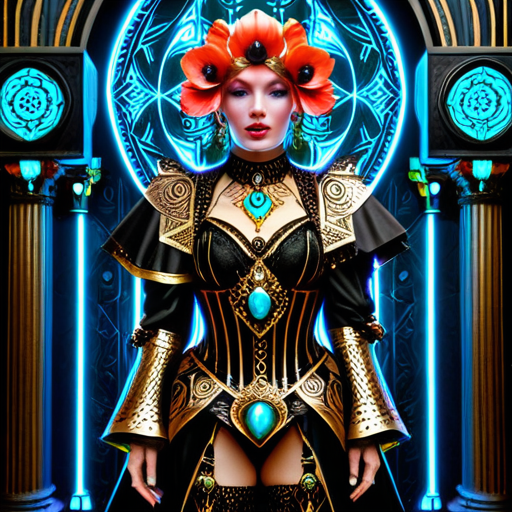
Noverra Digital Art Manifesto
The Color Codex: Ritual, Rhythm, and Rebellion
The symbolism, rhythm and rebellion of color in a hybrid art form
In Noverra , color is not decoration.
It follows a fixed rhythm:
Style Blend → Color Codex → Object Description
It is a vehicle for ritual, emotion, and intention.
While digital art often uses color for aesthetic effect, Noverra considers color an active force –
a visual voice that speaks in layers, contrasts, and symbols.
1. Color as character
Each color in Noverra has a personality.
They are not passive shades, but active elements in the visual narrative.
🔴 Deep Red – Ceremonial, Bloodline, Power
🟣 Purple – Mystical, Transformation, Inner Power
🟡 Gold – Ritual, Sublimity, Digital Nobility
🔵 Teal & Digital Blue – Technology, Distance, Synthesis
⚫ Black – Border, Depth, The Unknown
⚪ White – Silence, Transition, Spiritual Space
🟢 Green – Organic, Neo-Art Nouveau, Breathing Contrast
2. Color as rhythm
Noverra uses color not only as a carrier of meaning but also as a rhythmic element .
Color determines the visual breath of an image:
- Symmetrical use of color creates ceremony
- Asymmetrical use of color creates friction
- Color fading suggests transformation or decay
A Noverra image does not live through form, but through colour tension .
3. Color as rebellion
Noverra also uses color as a counterforce .
- A baroque scene with glitchy neon
- A Renaissance figure in digital blue
- A ritual object with brutal color disturbances
Color may clash. It must clash, even.
Because in Noverra, beauty isn’t smooth—it’s charged .
4. Color palette construction
When creating a Noverra image, you don’t choose colors—you build a palette .
- Choose 2 dominant colors (e.g. gold + black)
- Add 1 accent color (e.g. purple)
- Subtly fade or glitch 1 color (e.g. digital blue)
A good Noverra palette is like a ritual:
it has a structure, a tension, and a secret.
5. Why color first? It follows a fixed rhythm:
Style Blend → Color Codex → Object Description
In much digital art, color is chosen afterward—as decoration.
In Noverra, color comes before the prompt .
Color determines the tone, the emotion, the direction.
That’s why this expansion starts with and follows a fixed rhythm:
Style Blend → Color Codex → Object Description ) your prompt
so it never becomes a neglected child.
Example: Color before the prompt
Step 2 : Color choice as a starting point
You start with a color palette:
- Deep red (ceremony, power)
- Gold (sublimity, ritual)
- Black (border, mystical)
These colors already tell you something:
the image must be stately, charged with symbolism — perhaps even a digital rite.
Step 3: Promptly build around the palette
You write:
“A ceremonial figure in a post-digital temple, dressed in gold and deep red,
surrounded by black geometries that mark the boundary between reality and ritual.”
The color drove the narrative.
Without the palette, this prompt would never have been so charged.
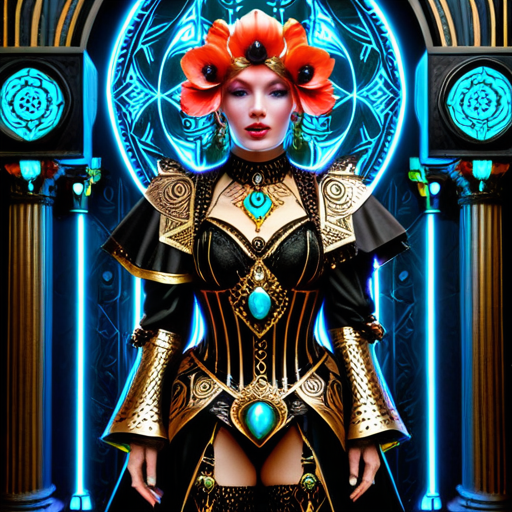
Step 3: Image curation
You generate multiple images.
Some are technically perfect, but lack color depth.
You choose the image where deep red dominates, gold glows, and black defines the composition.
Not because it is “beautiful” — but because it matches the color intention .
And that is Noverra:
color as ritual, as direction, as reason.
Not added afterward, but chosen beforehand-as the first incantation.
So yes, it’s a challenge.
But it’s also an invitation.
For artists who dare to rewrite their visual hierarchy.
➡️ On to Part 6 – Glossary
See “Codexrender I – From Thought to Zone” for a concrete example of how these principles lead to a successful render.
revision2

