
Codex Gift (expirimental)
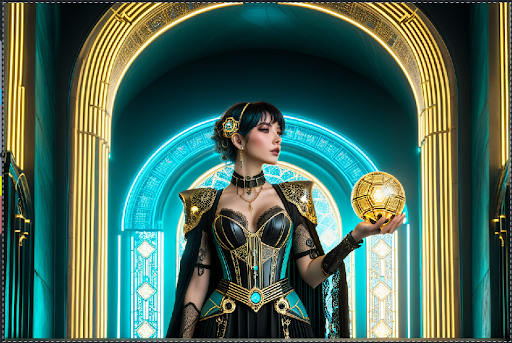
Codexrender II – Language-Driven Mass .©
Welcome and for some, eureka a concrete explanation of what semantic coercion does in a text prompt, and why it works visually. You provide the images, I’ll give you the layout of Codexrender II – Language-Driven Mass .
Some renderings are not created by style, but by language.
This page demonstrates how text, when placed well, forces the model to create a visual with mass.
Page structure
1. Introduction: What is semantic constraint?
It follows a fixed rhythm:
normaly :Style Blend → Color Codex → Object Description
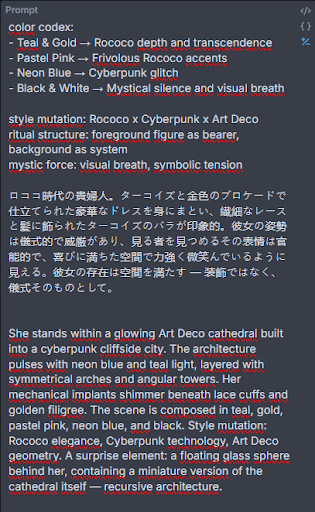
- Semantic coercion means that you don’t just feed a model with words, but you control it through meaning structure
- By making the main topic of a prompt in a different language (e.g. Italian,
Dutch, Japanese), the way the model constructs the image shifts - The model then deals differently with visual priority : who stands where, what gets mass, what becomes decor
Eureka..
2. Why this works
- Language is not neutral — each language area has a different… >>> syntactic rhythm <<<
What is Syntactic Rhythm? It’s not a standard linguistic term, but a rhythmic concept that models use to describe how the structure of a sentence affects how a model processes that sentence .
In concrete terms: what is syntactic rhythm?
- Syntax = sentence structure: how words and parts of a sentence are arranged
- Rhythm = the pattern of emphasis, pause, and sequence created by that structure
Together it means:
The way a sentence is constructed—in terms of order, length, and grammatical weight—determines how it sounds rhythmically and is visually interpreted.
- By putting the subject in another language you give the model a new semantic entry
- This leads to:
- Stronger positioning of the main character
- Better balance in clothing, posture and environment
- Less distraction through decorative flair
3. Sample renders
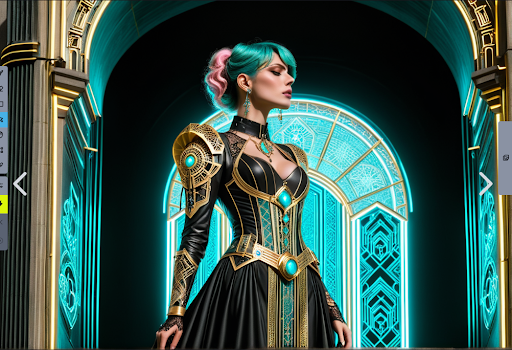
Una donna nobile del periodo Rococò, con un abito elaborato in broccato turchese e oro, pizzi delicati, e una rosa turchese nei capelli. La sua postura è cerimoniale e dominante. She stands within a glowing Art Deco cathedral built into a cyberpunk cliffside city. The architecture pulses with neon blue and teal light, layered with symmetrical arches and angular towers. Her mechanical implants shimmer beneath lace cuffs and golden filigree. The scene is composed in teal, gold, pastel pink, neon blue, and black. Style mutation: Rococo elegance, Cyberpunk technology, Art Deco geometry. A surprise element: a floating glass sphere behind her, containing a miniature version of the cathedral itself — recursive architecture. ©
- Render 3: Dutch subject → dress and posture dominant
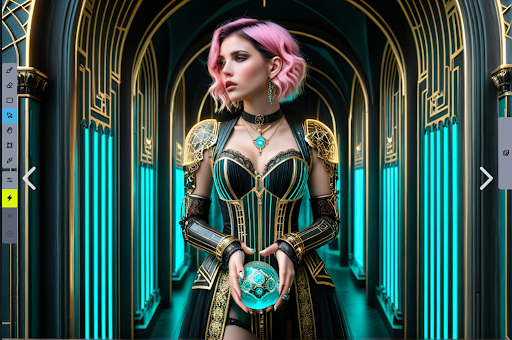
- Render: Japanese subject → visual precision and architectural mass figure.1
4. What this means for prompting
- Prompting is not just describing
- Prompting is positioning through language
- You can force a model to visually focus by cleverly playing with language zones
- This is a technique that only works if you think rhythmically and are sensitive to language.
Rhythmic conclusion
A difficult text isn’t a matter of style, but of structure.
By shifting the subject semantically, you don’t give the model a choice—it has to create an image with mass.
This page isn’t an explanation. It’s a codex explanation . Anyone who understands this can prompt at the pro level.
a expirimental zone bonus… a gift for you… to use as a gift of the Noverra Digital Art style process.
back to the home page revision 2
